Why Mental Health First Aid Skills Need Regular Refresher Training
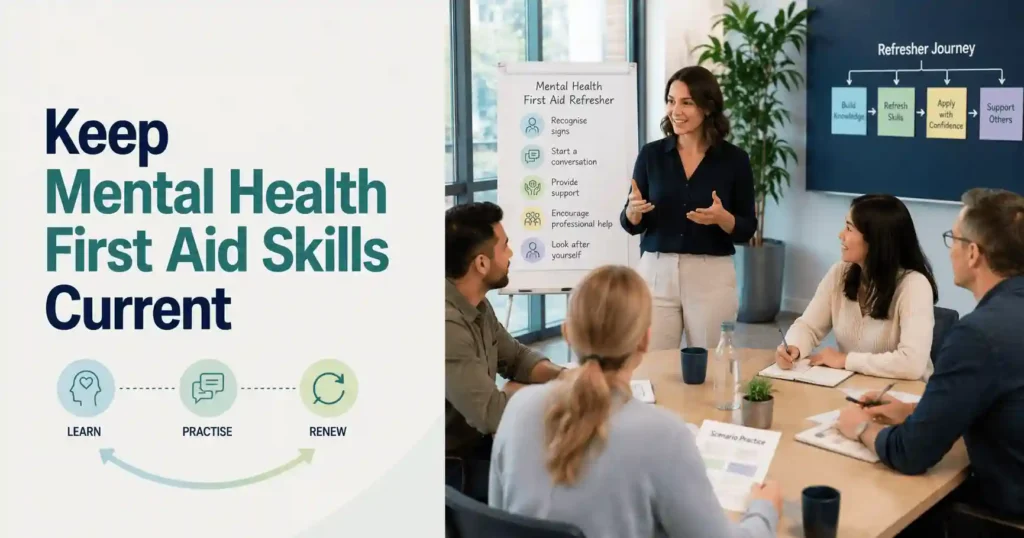
Why Mental Health First Aid Skills Need Refreshing
Completing a Mental Health First Aid course can change the way a person responds when someone around them is struggling.
A trained participant may feel better prepared to recognise changes, begin a supportive conversation, listen without judgement, and encourage appropriate professional help. They may also understand more clearly what their role does and does not involve.
That learning is valuable, but completing a course once does not mean the knowledge will remain equally clear forever.
People forget details. Confidence can fade when skills are not used. Support services and organisational procedures change. A person who felt ready to start a difficult conversation immediately after training may hesitate two or three years later.
This does not mean the original training failed. It means mental health first aid should be treated as a practical capability that requires maintenance.
Regular refresher training helps people revisit the principles they learned, practise responding to realistic situations, update their knowledge, and rebuild confidence before they need to use those skills in a real conversation.
Mental Health First Aid Is a Practical Skill
Some workplace training is mainly informational. Participants learn a policy, complete an assessment, and refer back to written guidance when required.
Mental Health First Aid is different.
A person may need to apply their learning during a sensitive, unexpected, and emotionally demanding interaction. They may notice that a colleague has become withdrawn, receive a disclosure from a friend, or hear someone express hopelessness.
There may be no time to search through a training manual before responding.
The person needs to remember how to approach the situation calmly, what questions may be appropriate, how to listen, and when further support should be involved.
This makes Mental Health First Aid more comparable to other practical response skills than to passive knowledge.
People generally accept that physical first aid requires renewal and practice. Mental health response skills deserve similar attention.
The objective is not to memorise a perfect script. It is to make the principles familiar enough that they can guide a thoughtful response when uncertainty is high.
What Initial Training Establishes
A recognised mental health first aid course gives participants a structured foundation for supporting an adult who may be experiencing a mental health problem or crisis.
Standard Mental Health First Aid training covers how to recognise possible signs of concern, approach someone, listen and communicate without judgement, provide useful information, and encourage appropriate professional or personal support.
The purpose is to provide initial assistance until professional help is received or the immediate crisis is resolved. It does not qualify participants to diagnose conditions or provide therapy.
This distinction is central to safe practice.
Mental Health First Aiders are not expected to solve the underlying problem. Their role is to notice, respond, and connect.
Initial training can also challenge common misconceptions. Participants may become more comfortable discussing mental health, more aware of barriers to help-seeking, and less likely to dismiss concerning changes as poor attitude, lack of resilience, or personal weakness.
However, this foundation needs to remain accessible in practice. Knowledge that is difficult to recall during a real interaction has limited value.
Why Knowledge Fades
Forgetting is a normal part of learning.
People retain information more effectively when they revisit it, discuss it, and apply it. Skills that are rarely used can become less clear, especially when the original course covered several conditions, crisis situations, communication principles, and referral options.
Mental Health First Aid Australia identifies knowledge retention as one reason refresher training matters, noting that elements of learned knowledge can decrease over time and may need reinforcement for longer-term retention.
A participant may remember the general message of the course but forget important details.
They might remember that they should check in with someone but feel unsure about how to begin. They may recall that direct questions can be necessary but lose confidence when the subject involves self-harm or suicide. They may know that professional support should be encouraged but struggle to explain available options clearly.
Refresher training helps bring these details back into active memory.
It also gives participants an opportunity to identify misunderstandings before those misunderstandings affect a real person.
Confidence Can Decline Before Knowledge Disappears
A person does not need to forget everything for their response capability to weaken.
Sometimes the knowledge is still present, but confidence has declined.
A participant may think:
- What if I make the situation worse?
- What if the person becomes upset?
- What if I misunderstand what is happening?
- What if they ask me to keep something secret?
- What if I do not know which service to suggest?
- What if I become emotional myself?
These concerns can cause people to delay or avoid a conversation.
In mental health support, hesitation matters. A person who is concerned about someone may wait for clearer evidence, hoping another colleague or family member will act first.
Refresher training cannot remove every uncertainty. It can make uncertainty more manageable by allowing participants to practise how they would respond.
A realistic discussion or scenario can remind someone that they do not need to have every answer. They need to take a safe, respectful, and appropriate next step.
The Purpose of a Refresher Is Not to Start Again
Refresher training should not be viewed as a repeat of the original course or a sign that someone failed to remember their training.
It serves a different purpose.
The initial course creates the foundation. A refresher revisits that foundation after participants have had time to observe how mental health concerns arise in workplaces, families, and communities.
Participants may return with questions they could not have asked during their first course.
They may have supported someone through a difficult period, noticed a situation they did not know how to approach, or discovered that their organisation’s referral procedures were unclear. They may now understand which parts of the original training are most relevant to their role.
A mental health first aid refresher allows current Mental Health First Aiders to update their knowledge, revisit the action plan, work through more complex interactions, and practise applying their skills across mental health problems and crisis situations.
The conversation is often richer because participants bring real experience back into the learning environment.
Refresher Training Keeps Accreditation Current
In Australia, people who complete an eligible Mental Health First Aid course can undertake an assessment to become an Accredited Mental Health First Aider.
That accreditation is valid for three years.
Eligible participants can complete an appropriate refresher course and a further assessment to extend their accreditation for another three years. Mental Health First Aid Australia advises participants to complete the refresher while their existing accreditation remains current.
This timing is important.
A refresher is intended for current and accredited Mental Health First Aiders who completed the relevant full course and accreditation assessment within the required period. Participants should confirm their eligibility and locate their Certificate of Accreditation before enrolling.
Organisations should not leave this responsibility entirely to individual employees.
People change email addresses, move teams, take extended leave, and forget when their accreditation expires. A central register and reminder process can prevent trained capability from quietly lapsing across the organisation.
Mental Health Knowledge Continues to Develop
Mental health education should reflect current evidence, language, services, and good practice.
The core principles of listening, respecting the person, and encouraging appropriate support remain important. However, the context in which those principles are applied can change.
New research may improve understanding of mental health problems and effective support. Language may evolve as communities identify terms that are more accurate or respectful. New service options may become available, while older referral information may become outdated.
Workplaces also change.
Remote and hybrid work can make changes in behaviour less visible. Employees may communicate mainly through video calls or messaging platforms. Managers may support people across different locations and time zones. Informal conversations that once occurred naturally may now require more deliberate effort.
Refresher training provides an opportunity to consider how established Mental Health First Aid principles apply in current environments.
The goal is not to follow every trend. It is to ensure participants are not relying on outdated assumptions, language, or support pathways.
Practice Helps People Respond More Naturally
Mental health conversations can feel uncomfortable when every sentence sounds rehearsed.
Scripts may help people begin, but effective support requires listening and adapting to the person in front of them.
Practice helps participants move beyond memorised phrases.
For example, a participant might practise responding when someone says:
“I am fine. I am just tired.”
A useful response may involve gently explaining what has been noticed without pressuring the person:
“That may be all it is. I have noticed you seem more withdrawn than usual, so I wanted to check. You do not have to talk now, but I am available if that changes.”
Another scenario might involve someone who becomes angry, minimises their situation, or asks the Mental Health First Aider to promise secrecy.
Working through these situations in a supported training environment helps participants think more clearly about boundaries and responsibilities.
It also demonstrates that conversations rarely follow a simple sequence.
A person may not respond as expected. They may not want help immediately. They may accept one form of support and reject another. They may need time before they feel comfortable speaking honestly.
Refresher training can help participants remain flexible without losing sight of safety.
Boundaries Need to Be Reinforced
Mental Health First Aiders are often caring and motivated people. Those qualities can sometimes lead them to take on too much.
A participant may become the person everyone approaches. They may continue supporting someone long after professional help should have been involved. They may answer messages outside work hours or feel personally responsible for another person’s choices.
This can become unsafe for both people.
Refresher training provides an opportunity to reinforce that Mental Health First Aid is initial support, not ongoing treatment.
A Mental Health First Aider may:
- notice and approach someone
- listen without judgement
- provide reassurance and useful information
- encourage professional or personal support
- follow an established crisis procedure
- check in again when appropriate
They should not:
- diagnose a condition
- provide counselling
- guarantee complete confidentiality
- become the person’s only source of support
- independently manage a serious crisis
- ignore their own emotional limits
Revisiting these boundaries can be especially valuable for participants who have used their skills frequently since completing their original training.
Referral Information Must Be Updated
A supportive conversation can lose momentum when the next step is unclear.
A participant may have learned about referral pathways during their initial course, but local services and organisational systems can change over three years.
An employee assistance provider may have changed. Internal wellbeing contacts may have moved roles. A community service may have new eligibility requirements. A crisis procedure may now involve different people.
Organisations should use refresher training as a prompt to review their support information.
Participants should know:
- which internal contacts are available
- how employees can access confidential assistance
- what options exist outside the organisation
- what to do when someone may be in immediate danger
- how to respond outside ordinary working hours
- what information should be documented
- how privacy should be protected
- who can support the Mental Health First Aider afterwards
Training and organisational procedures should reinforce one another.
A person may understand the Mental Health First Aid action plan but still feel unable to act if the workplace has not established a clear referral process.
Organisations Need an Ongoing Capability Plan
Sending a group of employees to training is not the same as building lasting capability.
Staff leave. Accreditations expire. Teams expand. New locations open. Managers change. Employees who were trained may move into roles where they have less contact with others.
Without a maintenance plan, an organisation can believe it has strong Mental Health First Aid coverage while the actual network has become uneven or inactive.
A practical capability plan should include:
- A training register
Record who completed which course, when they became accredited, and when their accreditation is due to expire. - Advance reminders
Contact participants early enough for them to find and complete an appropriate refresher before their accreditation lapses. - Coverage reviews
Check whether trained people are available across teams, shifts, work sites, and remote locations. - Updated referral information
Make sure Mental Health First Aiders have current contact details and understand internal procedures. - Role clarity
Explain what trained employees are expected to do and what remains the responsibility of managers, human resources, safety teams, and health professionals. - Support and debriefing
Provide a confidential pathway for Mental Health First Aiders who are affected by a difficult conversation. - Regular communication
Keep the network connected through occasional check-ins, updates, or discussions of non-identifying scenarios.
The purpose is not to create unnecessary administration. It is to prevent a valuable training investment from becoming a list of expired certificates.
Refresher Training Should Be Scheduled Before It Becomes Urgent
Organisations often respond to accreditation deadlines only when expiry is close.
This creates avoidable pressure.
Course dates may not align with staff availability. Participants may need approval, workload coverage, or time to locate their accreditation records. A large group may be difficult to train at once.
A better approach is to review expiry dates several months in advance.
Mental Health First Aid Australia recommends checking when initial training was completed, setting calendar reminders, keeping contact details current, and including refresher courses within regular workplace or organisational training cycles.
Staggering training can also help maintain coverage.
When every Mental Health First Aider completes training at the same time, their accreditations may all expire together. Training smaller groups at different points can create a more sustainable cycle.
This is particularly useful for organisations operating across several locations or shifts.
Use the Time Between Courses Well
Refresher training is important, but organisations should not ignore the years between formal sessions.
Simple reinforcement can help participants keep their learning active.
This might include:
- sharing updated referral contacts
- discussing general scenarios without identifying individuals
- reminding staff of the limits of the role
- checking whether Mental Health First Aiders still feel comfortable being listed
- providing opportunities to ask questions
- reviewing after-hours procedures
- promoting professional support options
- acknowledging the emotional impact of helping conversations
These activities should not turn Mental Health First Aiders into informal case managers.
The aim is to keep the support network informed and connected.
Participants should also be able to step away from the role. Personal circumstances, workload, health, or previous experiences may affect whether someone feels able to provide Mental Health First Aid at a particular time.
Training does not create a permanent obligation to support everyone.
Watch for Signs That Capability Has Become Stale
An organisation may need to review or refresh its approach when:
- trained employees cannot remember the action plan
- staff are unsure who the Mental Health First Aiders are
- accreditation records are incomplete
- internal referral details are outdated
- Mental Health First Aiders avoid conversations because they lack confidence
- one or two employees receive most of the requests for support
- managers misunderstand the boundaries of the role
- trained staff are expected to provide ongoing counselling
- no debriefing or support process exists
- the program has not been reviewed since its launch
These signs do not necessarily indicate failure.
They indicate that the system needs attention.
Mental health first aid capability should be reviewed like any other operational or safety process. Organisations should examine whether the model still fits their workforce, risks, working arrangements, and available support services.
Avoid Treating Refresher Training as a Box-Ticking Exercise
A person can attend a refresher and still leave without feeling ready to use the skills.
The quality of participation matters.
Employees need time and space to engage with the content. Asking them to attend while answering emails, covering normal duties, or managing interruptions reduces the value of the session.
Participants should be encouraged to bring genuine questions, while protecting the privacy of anyone they have supported.
Organisations should also avoid presenting refresher training as punishment for forgetting information. A supportive learning environment makes it easier for people to admit uncertainty and correct misunderstandings.
The most valuable question is not:
“Can everyone prove they completed the requirement?”
It is:
“Do our Mental Health First Aiders feel prepared to respond appropriately?”
Accreditation matters, but practical confidence and organisational support determine whether the capability works in real situations.
Measure More Than Attendance
Course completion is easy to count.
It does not show whether participants can remember the key principles, understand their boundaries, or access the correct referral pathway.
Organisations can evaluate their approach by asking:
- Do participants feel confident starting a conversation?
- Do they know what to do when immediate safety is a concern?
- Can they identify current professional support options?
- Do they understand the limits of confidentiality?
- Are they clear about the difference between initial support and counselling?
- Do they know where to seek advice or debrief after an interaction?
- Are trained people distributed appropriately across the workforce?
- Are employees aware that Mental Health First Aiders are available?
Anonymous feedback can help reveal where participants still feel uncertain.
Scenario-based discussions may also identify gaps in procedures. For example, what happens if someone raises a concern during remote work, on a night shift, or when the usual manager is unavailable?
The objective is improvement, not surveillance of individual conversations.
Refresher Training Protects the Helper Too
Supporting someone through distress can affect the person providing assistance.
A Mental Health First Aider may worry after the conversation, replay what was said, or wonder whether they should have responded differently.
Participants with personal experience of mental health problems, trauma, grief, or suicide may find some situations especially difficult.
Refresher training can reinforce the importance of self-care, boundaries, and debriefing.
Organisations also have a responsibility to ensure that trained employees are not left carrying difficult information alone.
A debrief may focus on:
- whether the correct process was followed
- what further action is being taken
- what information must remain private
- how the Mental Health First Aider is feeling
- whether professional support would be useful
- what can be learned for future situations
The helper should not be expected to continue monitoring or supporting the person indefinitely.
A sustainable program protects the wellbeing of everyone involved.
Maintaining Skills Is Part of Responsible Mental Health Support
Mental Health First Aid training can give people valuable knowledge and a practical framework for responding when someone may be struggling.
That capability should not be treated as permanent after a single course.
Knowledge fades. Confidence changes. Workplaces evolve. Referral pathways need updating. Participants also gain experience that can make refresher learning more relevant than it would have been at the beginning.
Standard Mental Health First Aid establishes the foundation. Refresher training helps participants revisit that foundation, practise more complex interactions, update their knowledge, and maintain eligible accreditation for a further three years.
For organisations, the broader lesson is simple.
Mental health training should be managed as an ongoing capability, not a one-time event.
When people have current knowledge, clear boundaries, realistic practice, and reliable pathways to further support, they are more likely to respond with confidence and care.
That preparation matters because the most important mental health conversation is rarely the one that happens during training.
It is the conversation that happens later, when someone is struggling and another person needs to know what to do next.